Tuesday, June 21, 2016

SE Asia, Labor movement and Trafficking/Population Migrations and Women.


Having come to this part of the world for several years now, I'm getting a better picture of the complexities of Thailand and to a certain extent Vietnam, Cambodia, Burma and Laos. The last two are next on my travel bucket list. The migration patterns in this part of the world is directly connected to cost of living, wages and other existential factors. The place of women is also problematic, as there are pressures on women both from the society and Western colonialist expectations of SE Asian women and girls.
The trafficking of labor in Asia seems to be widespread. Many voluntarily go for the sake of a job, but sometimes their handlers have a different agenda. Burmese, Cambodian and Laotian labor is very evident in Thailand. Your construction worker is often Burmese. The food service worker might be Khmer. Filipinos dominate the musicians in Thailand, since they speak English and can cover Hotel California without a problem.
In addition, due to ASEAN, there is a clear uptick in movements of transgender populations to Thailand. Unfortunately for the Thai Katoey, some of these new populations speak English much better, and might undercut their situation. However we look at the tolerance in Thailand for LGBT populations, some disproportionately end up in sex related industries.
What is unusual about illegal labor in Thailand is that they don't label the population necessarily in a negative manner. When you say illegal in America, it is automatically Mexican with a negative tone. You don't see this in Thailand, but there is clear exploitation of the population. Sometimes they earn 100 baht less than the equivalent Thai worker.
Women seem to be especially vulnerable. With the Rohingya, being refugees introduces opportunities for forced marriage. The trafficking of women seems to be going out of Thailand. Thai women are being shipped to various places like China. South Korean matchmakers are hooking up Vietnamese women with Korean men, and they end up beaten and abused. Basically, it's a front door version of trafficking. You don't hear about Laos, but I suspect it is happening there, as Thailand is cracking down. Sporadically, you see reports of shady Westerners molesting children in Laos. Lately, I view this sort of stuff as latent colonialism with a pervert's twist.
Why? It seems to be multiple vectors. Much of it would be market related and pay. Although Thailand doesn't pay like the US, they pay better than in Cambodia. Some of the refugee issues are triggered by religious conflict, but a lot of it is just plain socio-economics. With the ASEAN Economic zone, we might see more migrations of labor pools cross borders. Infrastructure build up is going crazy in Thailand, so there is a growth market here in construction labor. But with growth, there is a darker side to it. If you want a US example, look at what is happening in the fracking fields of North America. In the case of women, they are subject to the winds of international problems, and often they get a bad deal.

Bangkok's public transportation

Bangkok transit system.


If you strategically set it up, you can get around pretty easy in BK. Huay Kwang is actually pretty centrally located, and I am within easy walking distance to the MRT (Subway station) 10 to 15 minutes. There are pharmacies and 7/11 stores everywhere, and if you so desire, places to grab a pint whether in a bar setting or on a plastic stool. You won't notice the high concentrations of spirit houses and Wats, until you get out of your cages and walk.
Today, I'm burned out, because I went on as Bilbo would say, an adventure, but I forgot how hot it could get here. Largely because I'm on vacation, I decided to see how far the public transportation system could take me. 23 baht to take the MRT to Asok station for BTS (Skytrain) link. 140 baht for an all day pass. I may not use it to the max, but it cuts down the time waiting in line to buy tickets by coin. Asok to Siam Square. Siam Square to Taksin Bridge. Then a 150 baht all day boat ticket, although it was clear that the cut off was 5:30. Still, I would rather just pay for the convenience. You can pretty much hit all the tourist traps in Bangkok with the Chao Praya boats.
Unplanned. Got off the boat and ended up at Wat Pho. This is where there is a huge reclining Buddha. Nirvana Buddha pose. Was here before, but I took more careful shots. Did not go to Wat Arun, across the river, as it was under renovation.
Took the Chao Praya boat to see the Royal Barges. Well, it was deserted. And it was darn hot. But curiously, there was a museum in the hospital. Turned out to be not too bad, as you saw exhibits of a large river boat and other things about medicine in Thailand. Supposedly, there was a body of the serial killer on display, but didn't see that.
Got all at the Taksin Bridge spot. Walked to the Hangover sky bar. Took shots of the sunset wile drinking an overpriced drink. Most beer in BK is about 100 to 200 baht, depending. Nothing was cheaper than 500 baht, which basically is about right. Sort of a hipster rate USA level. Noticed a lot of "beautiful" people, both Thai and Euro.
Took the BTS back to Central Mall by Siam Square. Couldn't decide, and ended getting some spicy McD chicken sandwich. Not a good idea, as it sat and slowed me down today.
Total cost. MRT 46 baht total. BTS 140 baht. Chao Praya River boat, 150 baht. Way under 15 USD. The walking sort of was healthy too, as I'm getting heat about my weight.

Cost comparisons

Cost of living comparisons.  BK versus LA.

It's strange when you look at your budget, and it was cheaper to be on vacation than to have stayed at home in LA.  Generally, food and operational costs are very high in LA.  You can pretty much guarantee that you will at least blow about 60 dollars on food related purchases per week, if you are frugal.  With gas, it is minimally 45 dollars a shot.  If you eat out, one McD meal now is close to 8 dollars a shot.  If you eat at least twice at a fast food joint, you pretty much lost 20 US Dollars.  Although I spent about 400 dollars on a service apartment in BK, my total out of pocket costs have been substantially cheaper living out here.  And I'm living like a local.  I wash clothes in a sink.  Take the subway, skytrain, and taxis.  I have to get my Thai better, as I want to take taxis, but not all of the drivers speak English too well.

Some things are expensive.  If you eat at the malls, the meal goes for about 200 baht.  Street food can be as low as 10 baht, but my tummy took a hit, and I've resorted to mall food for the duration.  It's 30 baht per dollar roughly.  Still, a ramen combo meal in a mall costs about 5 dollars, and that includes the Coca Cola.

Technically, I was never on vacation, as I was teaching a class online.  The Internet is spotty in Thailand, as wifi isn't as easy to get as in Vietnam.  I've pretty much used 3g in BK, but unlimited.  That is about the same as the US, at around 30 dollars.  On the other hand, Vietnam can be expensive.  But the hotels are still about 40 dollars a night.  My Vietnamese sucks.  Another agenda item for me to improve upon.  

Bob Kerrey as head of Fulbright University Vietnam. Pulitzer Prize winner Viet Nguyen's response in the NY Times.


NY Times OP-Ed piece by Viet Nguyen, Pulitzer Prize Winner. 

Bob Kerrey is going to become the head of the Fulbright University Vietnam.  This has a number of ramifications.  Viet Nguyen notes in his piece that Kerry was involved in basically a war crime. 

The action in question is below.  This is an interview of a member of Kerrey's team. 


Kerrey going back to Vietnam seems complicated.  But if you have been monitoring things about the legacies of the VN War, you find that many of the Vietnam Vets find a sort of comfort in returning to their battlegrounds.  This is evident in the CBS story below.


Is Kerrey the best guy for the job?  Who really knows.

President Obama in Vietnam


President Obama visited Vietnam, and it was one of the most important trips that he has conducted.  If you check out his speech, he cites many Vietnamese legends, and it was well researched.

He even got into a discussion with VN Rapper, Suboi about the Arts.


So things have changed quite a bit since the Vietnam War.

Thursday, August 6, 2015

US Secretary of State Kerry in Vietnam 2015


The warming of relations between Vietnam and the USA is getting much more obvious.  Former Vietnam Vet, John Kerry is now in Vietnam.  The fact that Kerry is a Veteran of the Vietnam War can not be underestimated here.  


Vietnam's Nguyen Phu Trong's visit to the White House also was significant although the Diplomat, a journal on Asian geopolitics, reports that it is still in early stages.  Now there is open discussion about arms sales from the USA to Vietnam, which politically is split between Pro-China and Pro-West blocs internally within the Party. 


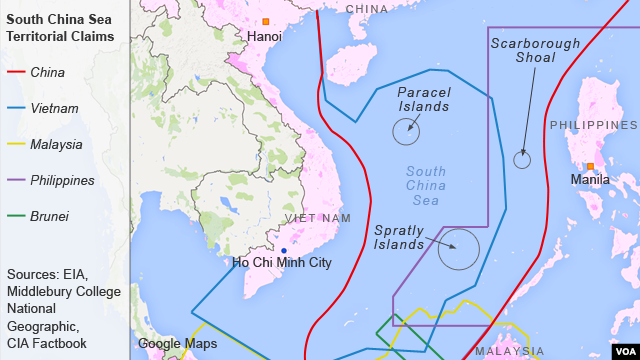
The Diplomat has an entire piece about the possibilities of the development of an alliance between the former foes.  In addition, the Vietnam Navy has activated a number of Russian submarines, which technically can deploy sea to land weapons.  The obvious adversary is China, as they have historically always been at odds.  China has always viewed Vietnam as a part of China, which might explain their perception of the South China Sea as their territory.  But this does create a tension with ASEAN.


The Voice of America reports that China now has stopped building basically military bases in the South China Sea after some discussions at the latest ASEAN meeting in Malaysia.  This was soon after Kerry spoke at the ASEAN meeting about restraint.  

The warming of relations between Vietnam and America will have some domestic implications in So Cal's Little Saigon.  Still adamantly against the Communist government, any sort of rapprochement with Vietnam will invoke protests, but this might be ignored in favor of trade and other security issues, especially in the South China Sea which is an important trade route that can affect South Korea and Japan.  

This situation bears watching and monitoring.  


Sunday, July 26, 2015

CNET's articles on Vietnam Tech

CNET posted a report on Vietnam largely beginning with the success of the App game, Flappy Bird.   The article states:

Over the past decade, Vietnam has expanded beyond its traditional textiles and coffee businesses to become a big player in the electronics manufacturing supply chain. Many of the world's smartphones are now assembled in the country, and giants such as Samsung have been growing their operations in Vietnam. The country, still run by a conservative Communist government, is now trying to figure out how to move beyond being just another cog in the manufacturing wheel.
 This was evident while being on the road as I saw a huge Samsung factory.

Another article focuses on the notion of educating the Vietnamese to be more tech oriented.


The title is obvious.  Schooling Vietnam: How Tech Companies are Training the Next Wave of Workers.  Samsung is real.  In fact, I wonder how many Galaxy phones are being made in VN.  The article states: 

Samsung remains serious about its investment here. Over the past seven years, the South Korean electronics maker has earmarked nearly $9 billion for facilities in Vietnam. That doesn't include the billions spent by other Samsung divisions and suppliers, such as a recent approval by the Vietnamese government for a $1 billion smartphone and tablet display factory in Bac Ninh province.
Already, Southeast Asia -- Vietnam in particular -- has eclipsed China in terms of total Samsung workers, and the region even overtook Korea last year as the largest employee base. Samsung employs about 110,000 workers in Vietnam, with the vast majority in its two smartphone factories in the Bac Ninh and Thai Nguyen provinces outside Hanoi. When the company's new $1.4 billion consumer electronics factory opens in Ho Chi Minh City in the first half of 2016, Samsung will add about 5,000 more employees to its payroll.
"Vietnam is now a growing country, so we have opportunities not only for business but also for workforce," Nguyen Van Dao, vice president of corporate marketing for Samsung's Vietnam operations, told me in the company's office in the Bitexco Financial Tower -- Ho Chi Minh City's tallest skyscraper.